The Elites — the Crowned Globe Sheet
The crowned-globe sheet — the endgame as heraldry: one world under one crown, the flags struck, the map redrawn as a single jurisdiction. The transmission where the one-world goal gets its coat of arms — and where the codex’s notes on the real consolidation literature run longest.
THE TWELFTH TRANSMISSION is the Red Series’ monument: the council enthroned beneath the world-government seal, the six-step strategy in marble and gold, and the endgame rendered as a golden globe wearing a crown — with the crowds of chaos and fear parted around it. Eleven sections.
11 sections · reproduced in full below · click the poster for full size

IN THE OPEN CONVERSATION
G. Edward Griffin, The Creature from Jekyll Island (1994) — “Follow the money” — the monetary case against the crowned globe, in the genre’s most reprinted volume.
Wikipedia · Amazon · X · Google
Carroll Quigley, Tragedy and Hope (1966) — The network behind the “plan centuries in the making” — the historian’s own account.
Wikipedia · Amazon · X · Google
Gary Allen with Larry Abraham, None Dare Call It Conspiracy (1971) — The strategy frieze’s six steps, argued as history fifty years before this sheet.
Wikipedia · Amazon · X · Google
The Banner — “The Elites” in Stone
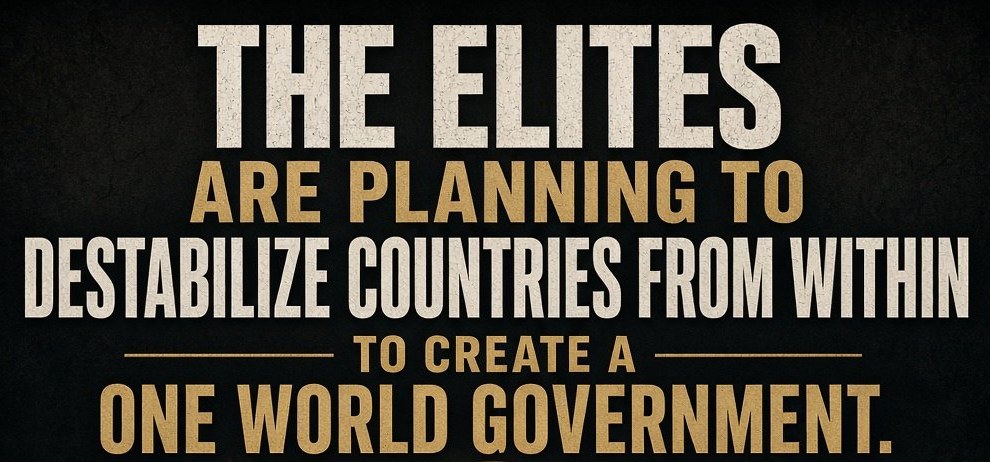
THE ELITES ARE PLANNING TO DESTABILIZE COUNTRIES FROM WITHIN — TO CREATE A ONE WORLD GOVERNMENT.
The twelfth sheet sets its title in weathered white stone — THE ELITES — larger than any other banner in the archive, as if the subject itself were the monument. The compilers noted the sheet’s nominal focus: not the plan this time but the planners — the series turning its lens from the playbook to the players.
The destination line returns in full gold — to create a one world government — underscored like a signature on a deed: the banner reads less as an accusation than as a dedication page.
The Enthroned Council — the Seal and the Agenda
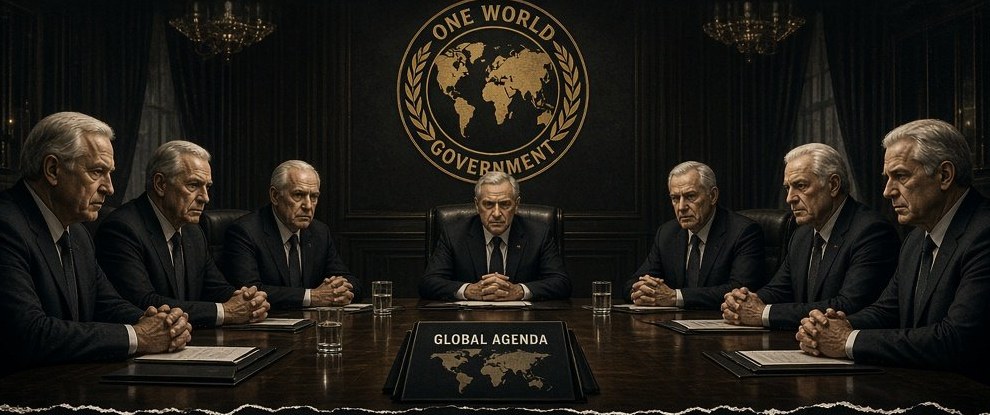
ONE WORLD GOVERNMENT (seal) — GLOBAL AGENDA (folder on the table)
The archive’s most formal council portrait: seven identical old men seated like a tribunal beneath chandeliers, a great circular seal on the wall behind them — ONE WORLD GOVERNMENT around a laureled globe — and on the table a single folder titled GLOBAL AGENDA. The compilers dwelt on the folder: the plan as a single document, tabbed and circulated, waiting on the table of every subsequent sheet.
The scene’s symmetry is its message: the chairman centered, the seal centered above him, the globe centered in the seal — power depicted as a series of nested centers, with the world at the bull’s-eye.
The Strategy — Six Steps in Marble

THE STRATEGY:
The band header reappears in its two-word form, here set over a torn-paper edge that divides the sheet’s two worlds: the council chamber above, the strategy’s engine room below. The compilers noted the graphic device: the tear is the sheet’s admission that the two scenes are one — the polished chamber ripped open to show the machinery.
The six steps beneath are the series’ most condensed: one line of instruction each, in gold, under six white icons — the playbook rendered as a monument’s frieze.
Step One — Divide and Conquer
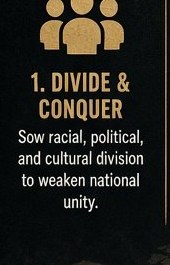
1. DIVIDE & CONQUER — Sow racial, political, and cultural division to weaken national unity.
The first step names the oldest imperial formula outright — divide and conquer — and applies it domestically: racial, political, and cultural division sown to weaken national unity. The compilers noted the sheet’s candor in using the classical phrase: where other sheets describe division as an instrument, this one names it as a doctrine — the plan’s genealogy traced to empire’s oldest page.
The divided-crowd icon is the step’s frieze: three figures with a crack between them, the nation split along a drawn line.
Step Two — Economic Sabotage
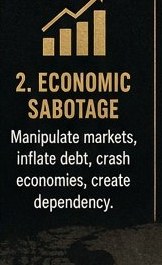
2. ECONOMIC SABOTAGE — Manipulate markets, inflate debt, crash economies, create dependency.
The second step upgrades the financial front’s verb: not undermining but sabotage — markets manipulated, debt inflated, economies crashed, dependency created, in the sheet’s most aggressive register. The compilers read the vocabulary shift as the monument’s tone: the plan described not as error or drift but as deliberate demolition with a foreman.
The market-graph icon — an arrow ascending before the fall — is the step’s frieze: the boom pictured as part of the trap, the rise engineered to make the crash instructive.
Step Three — Social Breakdown
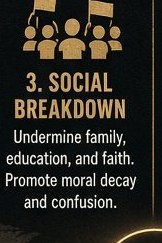
3. SOCIAL BREAKDOWN — Undermine family, education, and faith. Promote moral decay and confusion.
The third step targets the three forming institutions — family, education, faith — and names the product pair: moral decay and confusion. The compilers noted the pairing’s precision: decay is the corrosion of standards, confusion the loss of bearings — a population that no longer knows what is good or where it is.
The eroding-figures icon — a group losing its outline — is the step’s frieze: society as a sculpture being worn back to raw stone.
Step Four — Erode Sovereignty
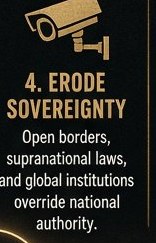
4. ERODE SOVEREIGNTY — Open borders, supranational laws, and global institutions override national authority.
The fourth step is the jurisdictional transfer: open borders below, supranational laws and global institutions above, national authority squeezed out between. The compilers noted the step’s legal tone: sovereignty is not seized but overridden — the nation outvoted in forums it cannot leave, by rules it did not write.
The surveillance-camera icon above this step — oddly paired, the compilers said — is the frieze’s quiet linkage: the erasure of borders and the growth of watching are the same policy wearing two badges.
Step Five — Control the Narrative
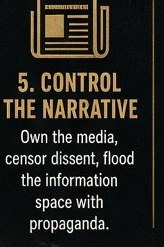
5. CONTROL THE NARRATIVE — Own the media, censor dissent, flood the information space with propaganda.
The fifth step is the information siege in three moves: own (the channels), censor (the opposition), flood (the space) — the archive’s most hydraulic image of propaganda: not argument but inundation, truth drowned in volume. The compilers noted the step’s realism: censorship by scarcity is obsolete; the modern method is censorship by flood.
The newspaper icon is the step’s frieze: the press as a held asset, its folds containing the day’s permitted thoughts.
Step Six — Engineer Crisis
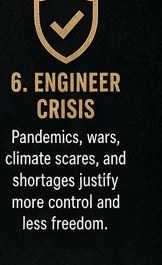
6. ENGINEER CRISIS — Pandemics, wars, climate scares, and shortages justify more control and less freedom.
The sixth step completes the circuit: pandemics, wars, climate scares, shortages — and, stated nowhere else so plainly, the exchange rate: more control and less freedom, justified. The compilers underlined the verb — justify — as the step’s core: the crisis’s true product is permission, and the emergency is only the invoice for it.
The shield-check icon — protection with a tick mark — is the step’s frieze and its irony: the crisis arrives dressed as safety, approved at the door.
The Crowned Globe — “One Currency. One Army. One System. No Escape.”
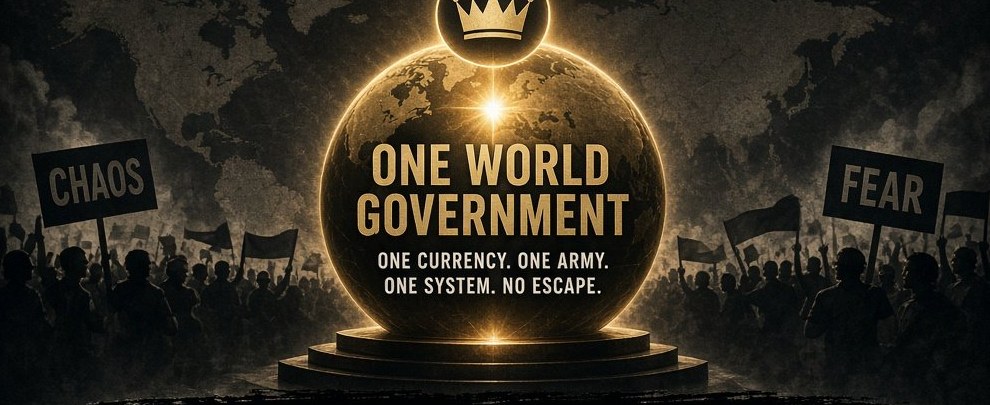
ONE WORLD GOVERNMENT — ONE CURRENCY. ONE ARMY. ONE SYSTEM. NO ESCAPE.
The sheet’s destination band is the archive’s most imperial image: a golden globe on a pedestal, wearing a radiant crown, flanked by crowds bearing signs that read CHAOS and FEAR — the two escorts of the coronation. The compilers read the composition as the plan’s own theory of crowds: the disorders do not oppose the crown; they usher it in.
The creed beneath the globe lists the endgame’s hardware — one currency, one army, one system — and closes with the series’ darkest couplet: no escape. The compilers noted the inclusion of army on this sheet alone: the monument’s admission that the final argument of the world state is force.
The Footer — “A Plan Centuries in the Making”

A PLAN CENTURIES IN THE MAKING. AWAKEN. UNITE. RESIST. — THEY WANT A WORLD WITHOUT BORDERS. WE WANT A WORLD WITHOUT THEIR CONTROL.
The footer opens with the archive’s deepest timestamp: a plan centuries in the making — the sheet’s answer to the objection of implausibility, the claim that the agenda’s patience is itself the evidence of its authorship. The standard triad follows — awaken, unite, resist — and then the footer delivers the series’ finest antithesis: they want a world without borders; we want a world without their control.
The compilers treated the closing couplet as the monument’s counter-inscription: the two utopias defined by what each removes — boundaries or masters — and the reader left to choose which subtraction to build.