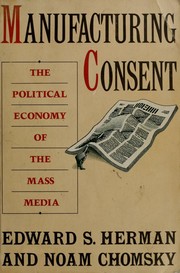
Manufacturing Consent
Edward S. Herman & Noam Chomsky · 1988
Manufacturing Consent (1988) is Edward S. Herman and Noam Chomsky’s ‘propaganda model’ of mass media — five filters that shape what populations hear, argued from evidence rather than suspicion. It is the scholarly peak of the Library’s media shelf: the codex’s media-control panels with footnotes.
The codex is speculative fiction; this source and the record below are real.
WHAT IT SAYS
The five filters
Ownership, advertising, sourcing, flak, and the dominant ideology — five structural filters that, the authors argue, make media serve power without anyone issuing orders. No conspiracy is required; the structure does the work.
Evidence, not accusation
The book’s method is comparative case study — ‘worthy’ and ‘unworthy’ victims counted in column inches. It is the least mystical book on this shelf and the hardest to wave away.
Why the canon claims it
Because it arrives at the grid’s conclusion through the academy’s door. The codex’s ‘the media is the weapon’ panels are its thesis minus its bibliography.
WHERE IT CAME FROM — THE RECORD
Published by Pantheon in 1988; Herman was a Penn economist, Chomsky the MIT linguist. The book became a standard text in media studies and the 1992 documentary adaptation extended its reach. Its model has been tested, criticized and refined for decades — the scholarly debate is the record, and it is linked above.
HOW THE CODEX USES IT
The codex’s media-control sections cite Herman and Chomsky as the documented pole of the claim. The Grounded Edition’s note: this is the version of ‘they control the narrative’ that you can assign in a seminar — and the one the mythology borrows most quietly.
QUESTIONS READERS ASK
What is the propaganda model?
Herman and Chomsky’s 1988 framework: five structural filters — ownership, advertising, sourcing, flak, and ideology — that make mass media serve established power without overt conspiracy.
Is Manufacturing Consent a conspiracy theory?
No — it is a structural argument about institutions, made from comparative evidence. Its conclusion rhymes with the mythology’s; its method is the opposite of the mythology’s.
Why is it in the codex’s Library?
Because the codex’s media chapters borrow its conclusions — and the Grounded Edition credits the borrowing. It is the scholarly floor under the grid panels.
What are the five filters?
Ownership concentration; dependence on advertisers; reliance on official sources; ‘flak’ disciplining deviation; and the dominant ideology supplying the frame.
SOURCES AND FURTHER READING
Wikipedia · Amazon · X · Google