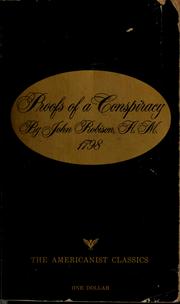
Proofs of a Conspiracy
John Robison · 1797
Proofs of a Conspiracy (1797) is John Robison’s claim that the suppressed Bavarian Illuminati survived and engineered the French Revolution through infiltration — the founding text of the entire hidden-hand genre, written by a Scottish physicist within a decade of the events. Every transmission in the Atlas descends from it.
The codex is speculative fiction; this source and the record below are real.
WHAT IT SAYS
The original hidden hand
Robison’s claim is exact: Weishaupt’s Illuminati, suppressed by Bavaria in 1785, went underground and drove the Revolution through the lodges. It is the first fully-formed version of the codex’s master plot — infiltration, deception, an invisible directorate.
A scientist’s certainty
Robison was no pamphleteer by trade — a professor of natural philosophy, a real scientist of the Enlightenment. The genre’s founding text arrives with a credentialed author, which is part of why it outlived every debunking.
What it started
Barruel wrote the companion volumes within a year; Webster revived both in 1924; the codex’s posters are their twenty-first-century format. The line from 1797 to the Atlas is unbroken.
WHERE IT CAME FROM — THE RECORD
Published in Edinburgh and Philadelphia in 1797, widely read on both sides of the Atlantic, and answered in its own decade by critics who noted Robison’s evidence was anecdote and correspondence. The Bavarian Illuminati existed and was suppressed — that much is documented. That it engineered the Revolution is the claim the record never supported.
HOW THE CODEX USES IT
Chapter I opens with Robison because the codex opens with its own founding document. The transmissions’ destabilization playbook is his structure with modern nouns. The Grounded Edition’s frame for him is the honest one: the genre’s founding father, and its first cautionary tale about certainty.
QUESTIONS READERS ASK
What is Proofs of a Conspiracy about?
A 1797 book by Scottish physicist John Robison claiming the suppressed Bavarian Illuminati engineered the French Revolution through infiltration of the lodges — the first hidden-hand bestseller.
Was the Bavarian Illuminati real?
Yes — a real secret society founded by Adam Weishaupt in 1776 and suppressed by the Bavarian state in 1785. That it survived and drove the Revolution is the part the record never supported.
Why is Robison’s book still read?
Because it is the template: every destabilization narrative since — Webster, Allen, the posters in this Atlas — runs on its architecture.
How does the codex use Robison?
As the founding layer of the real conversation the fiction is grounded in — the first page of the paper trail, cited by name in Chapter I.
SOURCES AND FURTHER READING
Wikipedia · Amazon · X · Google