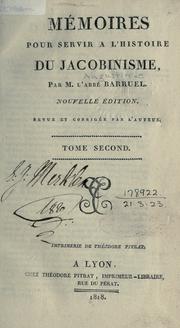
Memoirs Illustrating the History of Jacobinism
Abbé Augustin Barruel · 1797–98
Memoirs Illustrating the History of Jacobinism (1797–98) is Abbé Augustin Barruel’s four-volume anatomy of the French Revolution as a secret-society plot — the companion work to Robison’s Proofs of a Conspiracy, and the more widely read of the two in its century. It is the mythology’s second-oldest document.
The codex is speculative fiction; this source and the record below are real.
WHAT IT SAYS
The Revolution as a written plan
Barruel’s claim: the Revolution was not an uprising but an execution — plotted by the philosophes, carried by the lodges, armed by the Illuminati. Four volumes of names, dates and correspondence assembled by a Jesuit who had fled the Terror.
The Jesuit’s evidence
Where Robison argued from reading, Barruel argued from paperwork — circulars, membership lists, minutes. The method was new: the conspiracy presented as a documented archive, the genre’s first evidence binder.
Why it outlasted its century
It was the most read counter-revolutionary text in Europe, translated immediately and never out of circulation since. The codex’s ‘paper trail’ aesthetic — the dossier as proof — begins on Barruel’s desk.
WHERE IT CAME FROM — THE RECORD
Augustin Barruel (1741–1820), French Jesuit and émigré, published the four volumes in London between 1797 and 1798. The Illuminati existed and were suppressed — that much is documented. The continuity he alleged is the part the record never carried.
HOW THE CODEX USES IT
Chapter I cites Barruel beside Robison as the genre’s founding pair. The transmissions’ dossier format — panels as exhibits — is his method in poster form. The Grounded Edition’s note: the archive-as-argument begins here, and so does its weakness.
QUESTIONS READERS ASK
What is Memoirs Illustrating the History of Jacobinism?
Abbé Barruel’s four-volume 1797–98 work arguing the French Revolution was a secret-society plot — the companion to Robison’s Proofs of a Conspiracy.
Who was Abbé Barruel?
A French Jesuit and émigré (1741–1820) who wrote the counter-revolution’s most-read history, assembling documents to prove a hidden hand behind the Revolution.
Is Barruel’s account accurate?
His documents are real and his collection method genuine; his conclusion — a continuous hidden directorate — is the part historians have never confirmed.
Why does the codex cite him?
Because the transmissions’ evidence-binder format descends from his volumes — and because the record of what he got right (the societies) and wrong (the continuity) is the Library’s first lesson.
SOURCES AND FURTHER READING
Wikipedia · Amazon · X · Google