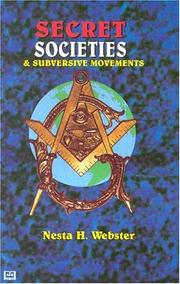
Secret Societies and Subversive Movements
Nesta H. Webster · 1924
Secret Societies and Subversive Movements (1924) is Nesta H. Webster’s revival of the Robison–Barruel tradition for the modern age — the bridge between the eighteenth-century Illuminati literature and its twentieth-century descendants. It is the least dated and most influential of the founding shelf.
The codex is speculative fiction; this source and the record below are real.
WHAT IT SAYS
The synthesis
Webster unified what Robison and Barruel had written separately: one continuous chain from the lodges through the revolutions to her own present. Her innovation was the throughline — history as a single ongoing plot rather than a series of episodes.
A writer, not a crank
Webster wrote with fluency and apparent scholarship — footnotes, sources, hesitation where the evidence thinned. The codex notes that the genre’s most durable revival was also its best-written.
The shadow on the legacy
The record includes what her admirers skip: Webster’s turn toward fascist sympathy in the 1930s. The Grounded Edition keeps it visible — the founding literature’s darkness is part of what the Library documents, not an embarrassment to hide.
WHERE IT CAME FROM — THE RECORD
Published in London in 1924; Nesta Helen Webster (1876–1960) was a respected historical writer before the conspiracy works. Her book became the standard reference of the interwar hidden-hand literature and was reprinted through the century. Her later politics are documented and carried in this entry’s record because they are part of the text’s history.
HOW THE CODEX USES IT
Chapter V’s hidden-hand sections cite Webster as the tradition’s hinge — the writer who made the nineteenth century’s materials feel contemporary. The Grounded Edition’s frame: the bridge, and the warning about where bridges lead.
QUESTIONS READERS ASK
What is Secret Societies and Subversive Movements about?
Nesta Webster’s 1924 synthesis arguing a continuous hidden hand runs from the Illuminati through the revolutions to the twentieth century — the genre’s best-written revival.
Who was Nesta Webster?
A British historical writer (1876–1960) whose 1924 book became the standard reference of the interwar hidden-hand literature — and whose later fascist sympathies are part of its record.
Is Webster’s book used by scholars?
It is cited as a primary document of the genre’s history — read as an artifact of interwar suspicion, not as reliable history.
Why does the codex include her?
Because the transmissions’ single-plot architecture is hers — and because her trajectory is the Cautions shelf’s founding argument for reading the genre carefully.
SOURCES AND FURTHER READING
Wikipedia · Amazon · X · Google