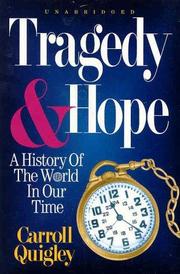
Tragedy and Hope
Carroll Quigley · 1966
Tragedy and Hope (1966) is Carroll Quigley’s 1,300-page history of the twentieth century by a Georgetown professor who taught at its foreign-service school — famous in the wider conversation for its pages on the ‘Anglo-American establishment’ and its networks of influence. It is a real scholarly work, selectively quoted by the canon ever since.
The codex is speculative fiction; this source and the record below are real.
WHAT IT SAYS
The famous establishment pages
Quigley describes the Milner Group and its successor networks — real circles of influence in British and American policy — with a historian’s calm. “The two systems… can be drawn from the same source,” he writes of capitalism and communism’s shared financial patrons — a sentence the canon has quoted ever since.
A critic of secrecy, not a theorist of the plan
Quigley’s complaint was scholarly: these networks shaped events without accountability and without historians being allowed to write about them. He wrote from inside the seminar, not from the barricade.
Why the canon adopted it
Because it is real. A respected professor, a major publisher, pages of named names and dated meetings. The mythology’s deepest need — a respectable citation — is what Tragedy and Hope supplies.
WHERE IT CAME FROM — THE RECORD
Carroll Quigley taught at Georgetown’s School of Foreign Service; Macmillan published the book in 1966. Its later life is a publishing saga: the plates were famously destroyed, pirate editions circulated, and Quigley spent years fighting for a corrected reprint. Scholars of the period treat the ‘establishment’ chapters as contested institutional history — not as evidence of a single directing hand.
HOW THE CODEX USES IT
In the codex, Quigley is the respectable floor of the hidden-hand thesis: the documented networks behind the mythology’s darker claims. The Grounded Edition keeps the distinction visible — what Quigley documented, what he speculated, and what the canon added afterward.
QUESTIONS READERS ASK
What is Tragedy and Hope about?
A 1966 macro-history of the twentieth century’s power systems by Georgetown professor Carroll Quigley, including its famous chapters on Anglo-American financial and policy networks.
Did Quigley expose a secret world government?
He documented real, influential networks and criticized their secrecy. He did not claim a single world government, and scholars read his account as institutional history, not conspiracy proof.
Why is the book famous in conspiracy literature?
Because it offers named names, dated meetings and a credentialed author — the most respectable citation the canon possesses.
Is it readable today?
It is dense and long, but in print and online. The codex’s trail ‘The Hidden Hand’ starts there for a reason.
SOURCES AND FURTHER READING
Wikipedia · Amazon · X · Google