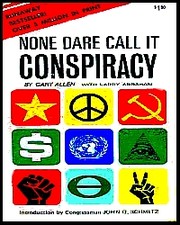
None Dare Call It Conspiracy
Gary Allen with Larry Abraham · 1971
None Dare Call It Conspiracy (1971) is Gary Allen and Larry Abraham’s pocket-sized argument that a network of financiers directs world events — the book that carried the hidden-hand thesis from pamphlet culture to the mass market, selling in the millions and defining the genre’s populist voice.
The codex is speculative fiction; this source and the record below are real.
WHAT IT SAYS
The mass-market thesis
Allen’s argument is a chain: finance → politics → media → the public mind. Written for the paperback rack, it compressed Quigley’s establishment history into a hundred-page brief — “This may answer ninety percent of your questions,” the opening gambit runs.
The title’s trick
The title dares the reader to name what they already suspect. The codex notes it as the genre’s perfect marketing device — the accusation completed by the buyer.
Its place in the lineage
Between Robison (1797) and the poster age, Allen is the bridge: the Illuminati literature re-voiced as 1970s populism, without the occult and without the footnotes — and vastly more read than either.
WHERE IT CAME FROM — THE RECORD
Published by Concord Press in 1971 and reprinted by Bantam for the mass market, the book sold into the millions and became the default gift of the hidden-hand readership. Gary Allen was a Birch Society writer; Larry Abraham a Washington publisher. Its sources are thin and its reach was enormous — both are the record.
HOW THE CODEX USES IT
The codex’s transmissions borrow Allen’s tone — the charge sheet, the plain reader, the dare. Chapter I’s destabilization argument cites him as the moment the thesis went paperback. The Grounded Edition’s note: influence documented, evidence thin.
QUESTIONS READERS ASK
What is None Dare Call It Conspiracy about?
A 1971 bestseller by Gary Allen and Larry Abraham arguing that a network of financiers and insiders directs world events — the hidden-hand thesis in mass-market form.
Who wrote None Dare Call It Conspiracy?
Gary Allen, with Larry Abraham — both associated with the John Birch Society’s orbit. It sold in the millions through the 1970s.
Is the book considered reliable?
Its influence is documented; its sourcing is thin and its thesis is contested. The codex files it as the genre’s bridge to the mass market, not as evidence.
Why does it matter to the codex?
It is the tonal ancestor of the transmissions — the plan as a plainspoken charge sheet addressed to the ordinary reader.
SOURCES AND FURTHER READING
Wikipedia · Amazon · X · Google