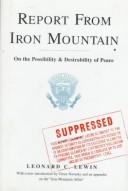
Report from Iron Mountain
Leonard C. Lewin · 1967
Report from Iron Mountain is a 1967 book presented as a leaked study by a secret government panel on the consequences of peace — concluding that war is the foundation of social stability and that substitutes must be invented if it ends. Its author, satirist Leonard C. Lewin, admitted the hoax in 1972. It remains the textbook case of a satire absorbed as a blueprint.
The codex is speculative fiction; this source and the record below are real.
WHAT IT SAYS
The argument it pretends to make
The ‘panel’ reports that war performs irreplaceable functions — economic discipline, social cohesion, population control, national purpose — and that a government facing lasting peace would need to manufacture substitutes: an environmental threat, an external enemy, a managed crisis.
The lines the mythology keeps
Its most-quoted idea is that peace would require ‘a giant space race’ or an equivalent fear-substitute. The codex’s crisis-events chapters quote this register exactly: the emergency as a technology of governance.
Why people believed it
It is written in perfect Rand Corporation deadpan — committees, caveats, footnotes. Lewin understood that the most persuasive lie about power is one power could plausibly tell, and wrote that.
WHERE IT CAME FROM — THE RECORD
The record is settled. Leonard C. Lewin, a writer and satirist, conceived the book; the New York Times reviewed it as satire in 1967, and Lewin confirmed his authorship in 1972. No such study group existed. Yet the book was reprinted for decades as ‘possibly genuine’ and circulates in the canon to this day — which is itself the lesson the codex draws from it.
HOW THE CODEX USES IT
In the codex, Iron Mountain is the prototype of the crisis playbook: the document that ‘admits’ emergencies are useful. The Grounded Edition places it on the Cautions shelf with its own label — a satire, repeatedly mistaken for the thing it mocked, and more influential as a mistake than most real documents ever are.
QUESTIONS READERS ASK
Is the Report from Iron Mountain real?
No. It was written by satirist Leonard C. Lewin in 1967 and he said so publicly in 1972. There was no secret study group and no report.
What is the Report from Iron Mountain about?
A fictional government panel concludes war is essential to social stability and that peace would require manufactured substitutes — environmental catastrophe, external enemies, managed crises.
Why do people still cite it as genuine?
Its deadpan is flawless, its thesis flatters suspicion, and editions kept appearing without the satire label. The codex documents this lifecycle explicitly.
What does the codex use it for?
As the proof that the genre’s documents can be forged, satirical, or mistaken — and that the mythology metabolizes them anyway. It is the Grounded Edition’s central cautionary file.
SOURCES AND FURTHER READING
Wikipedia · Amazon · X · Google