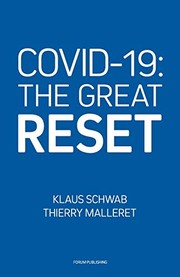
COVID-19: The Great Reset
Klaus Schwab & Thierry Malleret · 2020
COVID-19: The Great Reset (2020) is a real book by World Economic Forum founder Klaus Schwab and economist Thierry Malleret, arguing that the pandemic should be used to accelerate reforms toward ‘stakeholder capitalism.’ It is also the most contested title in the modern canon — read by its critics as a plan and by its authors as a recommendation. The record of what it actually says is short, public, and worth reading first.
The codex is speculative fiction; this source and the record below are real.
WHAT IT SAYS
What the book actually argues
That the pandemic exposed fragilities — supply chains, inequality, institutional debt — and that governments should use the recovery to rebuild differently: greener, more digitized, more coordinated. Its register is managerial, not menacing; the critique lies in what ‘coordinated’ implies.
Why it became the flashpoint
The phrase ‘the Great Reset’ — the WEF’s June 2020 initiative — landed in a year of lockdowns as a named, dated, branded program. The canon’s reading (‘they said the quiet part’) and the book’s actual content (‘here are some reforms’) have run on separate tracks ever since.
The codex’s use versus the text
The mythology treats the book as the plan’s cover sheet. The Grounded Edition’s note is simple: the book is real, its authors and publisher are real, its recommendations are modest — and its title became the mythology’s most successful piece of borrowed branding.
WHERE IT CAME FROM — THE RECORD
Published by Forum Publishing in July 2020 as a WEF-companion volume. The ‘Great Reset’ initiative launched the same month at the Forum. Fact-checks (Reuters, 2021 and after) documented that viral claims about the book — ownership abolition, forced vaccination programs — do not appear in its pages. Both the text and the corrections are linked above.
HOW THE CODEX USES IT
The codex’s Transmission-era panels quote the Reset branding directly. The Grounded Edition answers with the boring, load-bearing sentence: read the book before you file it. The chapter’s Claim · Record · Contested table carries this title in its center cell.
QUESTIONS READERS ASK
What does The Great Reset book actually say?
That the pandemic recovery should accelerate reform toward stakeholder capitalism — greener, more digital, more coordinated economies. It is a managerial argument, not a plan for world government.
Did Schwab say ‘you’ll own nothing’?
No. That phrase comes from a 2016 essay by Ida Auken, a Danish MP writing a thought experiment for the WEF’s content site — not from this book and not from any WEF policy.
Is the Great Reset a real program?
Yes — a real WEF initiative launched June 2020, public and documented. What it contains is a set of reform proposals; what the mythology overlays on it is the codex’s study.
Why does the codex engage it?
Because it is the modern canon’s hinge: a real document, a real institution, and a real gap between what the text says and what the conversation says it says. That gap is the codex’s subject.
SOURCES AND FURTHER READING
Wikipedia · Amazon · X · Google