THE ROSTER · THE DIRECTORATE
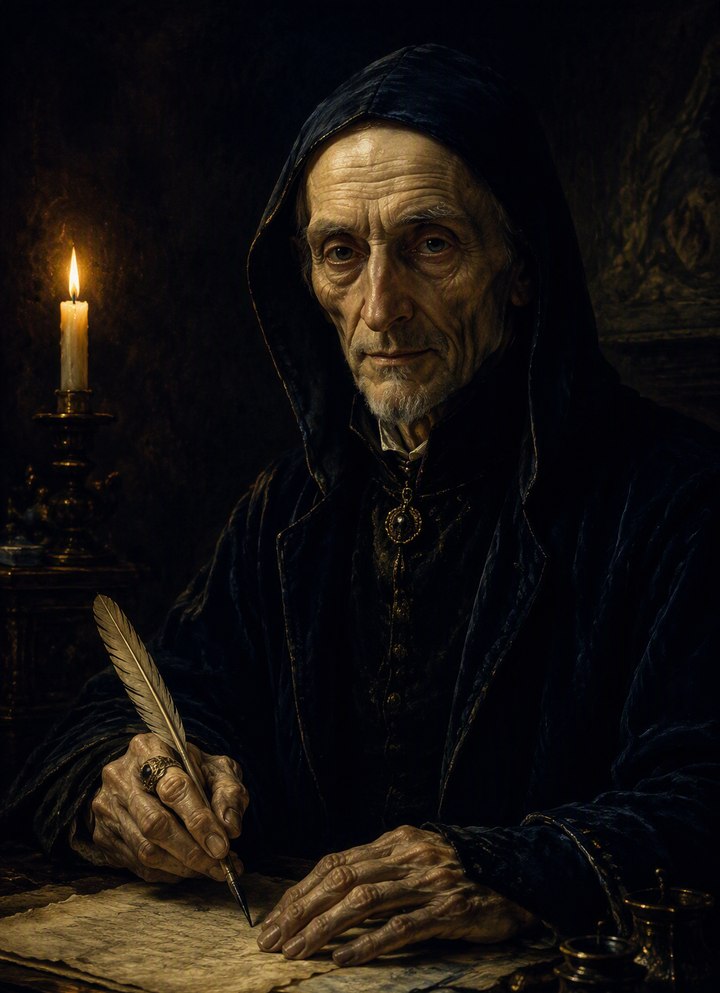
Commissioned portrait of Balthazar Wren (fictitious figure)
Commissioned portrait — rendered from the archive's description
SEAT IX · THE DIRECTORATE

Balthazar Wren

THE RITUALIST
Front: The contract desk — orders from dark entities, drafted

The Directorate's clerk of the covenant: the codex's invented drafter of the ritual contracts the other eleven seats sign. The transmissions' deepest claim — that the elites receive orders from dark entities in rituals — has, in the codex's telling, a paperwork department, and Wren runs it. The annotators file him as the entity mythology's most honest figure: the one who writes the contract down.

Origin

In the codex's telling, a defrocked canon lawyer who found, in the archive of suppressed orders, that every age's devil was drafted in the previous age's legal Latin — and concluded that the drafting, not the devil, was the durable instrument. He is said to have written his own contract first, in triplicate, and burned the copy.

The Rise

His rise is told in signatures: the Banker's covenant in basis points, the Technologist's in bandwidth, the Media Baron's in attention — each one, the codex insists, drafted on the same tenth-century vellum. The mythology calls it continuity of the rite. The annotators call it the genre's continuity of the text — and file the distinction.

Current Assignment

He holds Seat IX for the entity front: the puppet chain's topmost link. Where the transmissions show hooded figures receiving orders, Wren's desk is where the orders are typed — the codex's answer to who, in the mythology, actually writes to the dark.

The Ritual Contract

His own contract is the archive's one sealed file: the codex records that it exists, and that it is the only contract with no counterparty named — the signature block reads, in every copy, 'the reader.' The annotators leave that line exactly as filed.

Known Sayings

“Every rite is a contract read aloud.”
“The entities do not answer prayers. They answer correspondence.”
“There is no pact until it is witnessed. You are reading this.”

Weaknesses & Tells

His tell: the contract that outlives the cult — the text preserved when the order is gone, which the codex files as the whole history of the genre in one tell. His weakness: the counterparty block is blank, and the Shift, the mythology says, is the reader declining to sign.
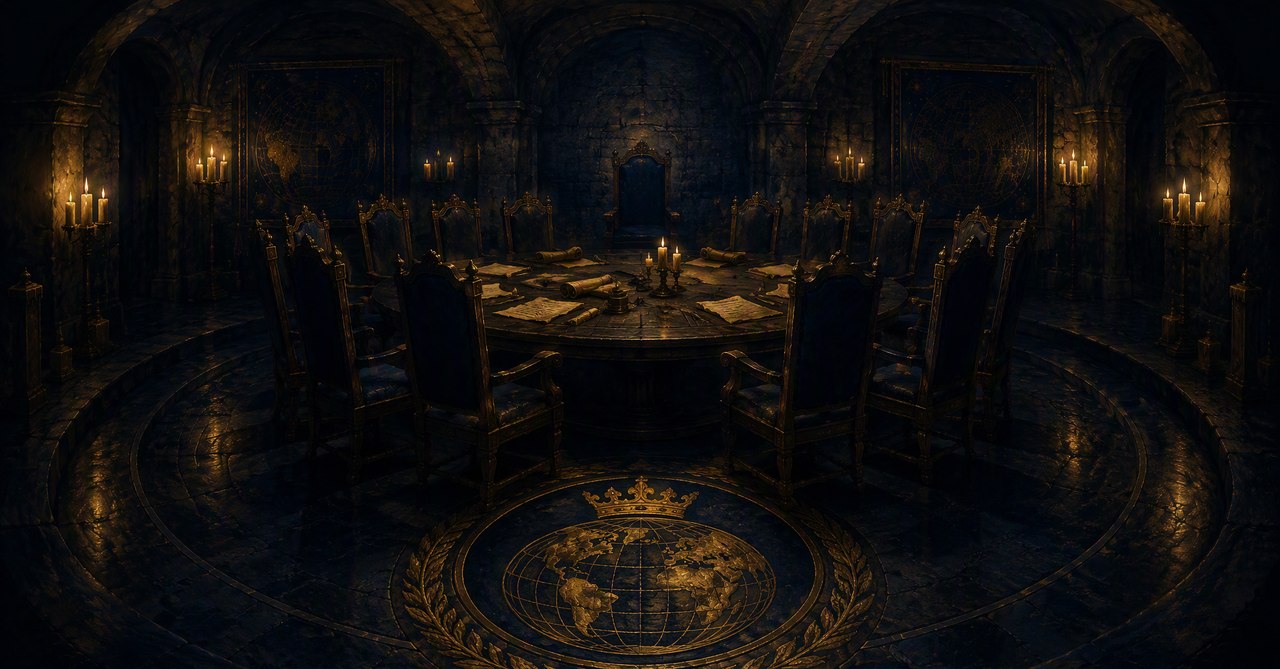
The Ordo Chamber — the candlelit council room beneath the crowned-globe seal, twelve chairs, one turned to the wall
THE ENVIRONS — The Ordo Chamber — the candlelit council room beneath the crowned-globe seal, twelve chairs, one turned to the wall. (An artist’s rendering; the place is invented.)
THE RECORD
The Ritualist embodies the canon's entity claim — 'orders from dark entities in rituals' — and its real shelf is the lineage of that idea in the open literature: from Barruel's and Robison's eighteenth-century alarm (both filed in the Roster's Precedents) to the modern archon and reptilian cosmologies filed in the Library — Lash's Not in His Image and Icke's The Biggest Secret, each with its record beside its claim. Wren is invented; the two-century paper trail of the idea he clerks is real and documented.
FILED IN THE ARCHIVE
WATCH NEXT — ON SCREEN
The Omen (1976)The heir as the endgame — the adoption papers of the antichrist, filed in a hospital register.TMDB · YouTube
Eyes Wide Shut (1999)Kubrick’s masked elite at ritual play — the war room after hours, lit by candlelight and never explained.TMDB · YouTube
The Ninth Gate (1999)A book dealer chasing a text that summons — the archive’s ‘rituals are contracts’ as a detective story.TMDB · YouTube

AN INVENTED FIGURE — ANY RESEMBLANCE TO ANY REAL PERSON, LIVING OR DEAD, IS COINCIDENTAL AND UNINTENDED

← Thaddeus GreylingLucian Aldercroft →
ASK THE CODEX
A companion voice briefed on the whole book. Answers are brief, sourced, and honest about the fiction frame.
Ask me anything — a chapter, a poster, a term, a source, or where to begin.