Commissioned portrait — the Directorate sits for no one else
SEAT I · THE DIRECTORATE
Aurelian Strohm
THE BANKER
Front: Destabilization through debt
Third master of the Strohm counting house, an invented private bank the codex seats older than most governments. Strohm does not appear in the transmissions' puppet galleries — the Banker never does. He appears in the arithmetic beneath them: the engineered crisis, the purchased recovery, the rescue that costs a nation its furniture.
Origin
Born, in the codex's telling, into a house that had already survived three currencies and two empires, and raised on the family's single lesson: nations fall when their money is believed in, and are bought when it is not. He is said to have taken his first position at twelve — a jar of depreciated notes, kept as a reliquary.
The Rise
The codex gives him no deals and no headlines — the Banker's rise is told in other people's ruins. A grain panic here, a conversion crisis there, each one followed by the house's quiet acquisition of what the panic undervalued. By the transmissions' account, he has never once predicted a crisis. He has only ever been early.
Current Assignment
He holds Seat I for the plan's first front: destabilization from within, priced in advance. The codex's panels call it 'economic collapse, engineered crises' — Strohm's office is where the engineering is costed, insured, and sold on.
The Ritual Contract
His ritual contract — the codex is precise here — is not written in blood but in basis points: a standing obligation to keep the price of stability one percent higher than the public can bear, forever. The entities, the mythology says, are paid in the difference.
Known Sayings
“Stability is the most expensive product we sell — so we are never out of stock.”
“A nation in debt is a customer. A nation in crisis is a harvest.”
“I have never predicted anything. Prediction is for those without positions.”
Weaknesses & Tells
His tell, the codex's annotators note, is the rescue that arrives pre-printed. His weakness: he has owned everything except an exit — the whole position is long, and the Shift, in the mythology's terms, is the one default he cannot price.
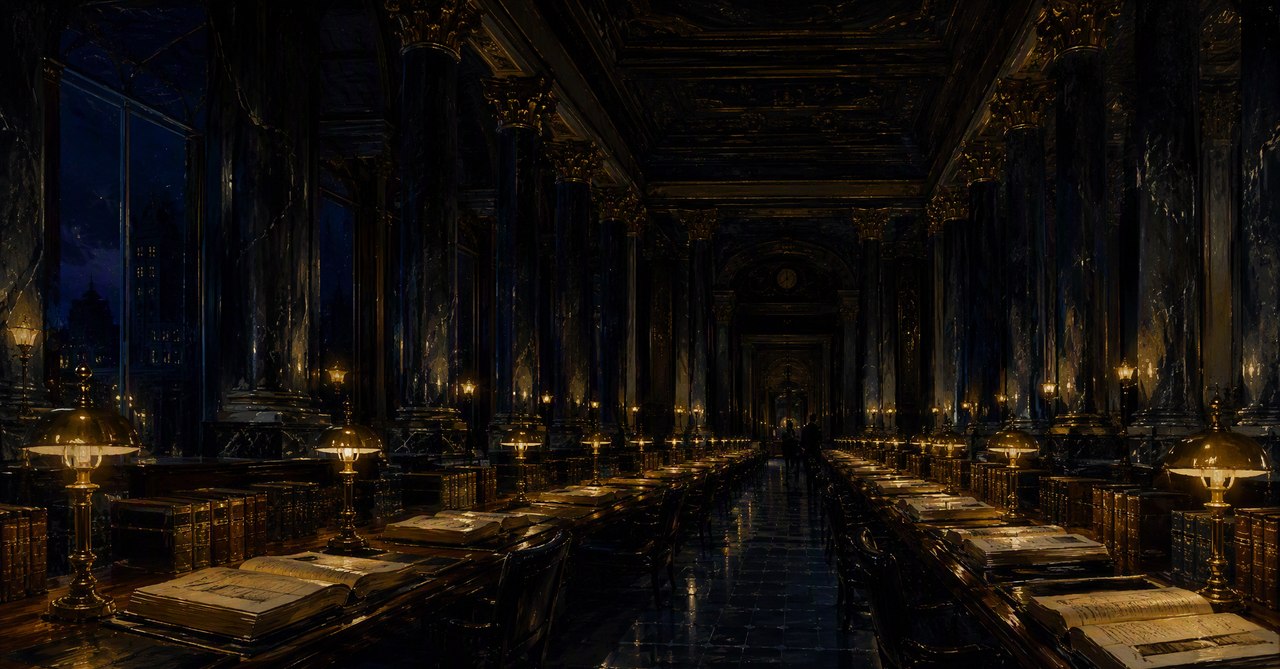
THE ENVIRONS — The Counting Hall — the Strohm house's private ledger room, where the ledgers are read aloud once a decade. (An artist’s rendering; the place is invented.)
THE RECORD
The Banker embodies the canon's oldest documented argument: that private banking houses shape nations from offstage. Its real shelf is in the Library — G. Edward Griffin's The Creature from Jekyll Island (1994), the record of the 1910 meeting and the Federal Reserve it produced, filed with its claims and its contestations side by side. The codex's rule applies: the Strohm house is invented; the debate about who writes a nation's money is real and well documented.