
THE ROSTER · THE DIRECTORATE
Commissioned portrait of Elias Mordant (fictitious figure)
Commissioned portrait — rendered from the archive's description
SEAT II · THE DIRECTORATE

Elias Mordant

THE GENETICIST
Front: Replacement — the controllable person, made to order

Director of the Mordant program, the codex's invented replacement institute. Where the Banker prices the crisis and the Technologist scores the citizen, the Geneticist supplies the body: the panels' 'controllable people,' grown rather than persuaded. The codex's annotators file him as the replacement mythology's necessary inventor — the plan's most monstrous claim, drawn as a man at a bench.

Origin

In the codex's telling, a developmental biologist dismissed from two universities for the same sentence — 'ethics is a latency problem' — and collected by the Directorate before the second severance was signed. He is said to keep the two dismissal letters framed above his bench, the way other men keep degrees.

The Rise

His rise is told as a series of vanishing constraints: first the funding, then the review board, then the species barrier itself — the codex's panels show each one dissolving in sequence. The mythology insists the sequence was arranged. The annotators note only that the mythology needs it arranged, and that the real record of cloning is filed below, beside the claim.

Current Assignment

He holds Seat II for the replacement front: the clone grid, the lookalike populations, the 'facilities underground' of the transmissions. In the plan's arithmetic he is the supply chain of the third goal — the controllable person, made to order.

The Ritual Contract

His ritual contract is the codex's coldest after Vale's: written not in blood but in cell lines — a covenant to keep improving the copy until the copy cannot tell. The transmissions draw him signing in duplicate.

Known Sayings

“A population that can be grown is a population that can be recalled.”
“The original is a proof of concept.”
“Ethics is a latency problem. We are working on it — slower than Vale, but we are working.”

Weaknesses & Tells

His tell, in the codex's panels: the replacement who arrives perfect — when the real record of cloning is a record of failures, filed below. His weakness: the program perfects the body and cannot touch the testimony — the Shift, the mythology says, is the one thing no cell line survives.
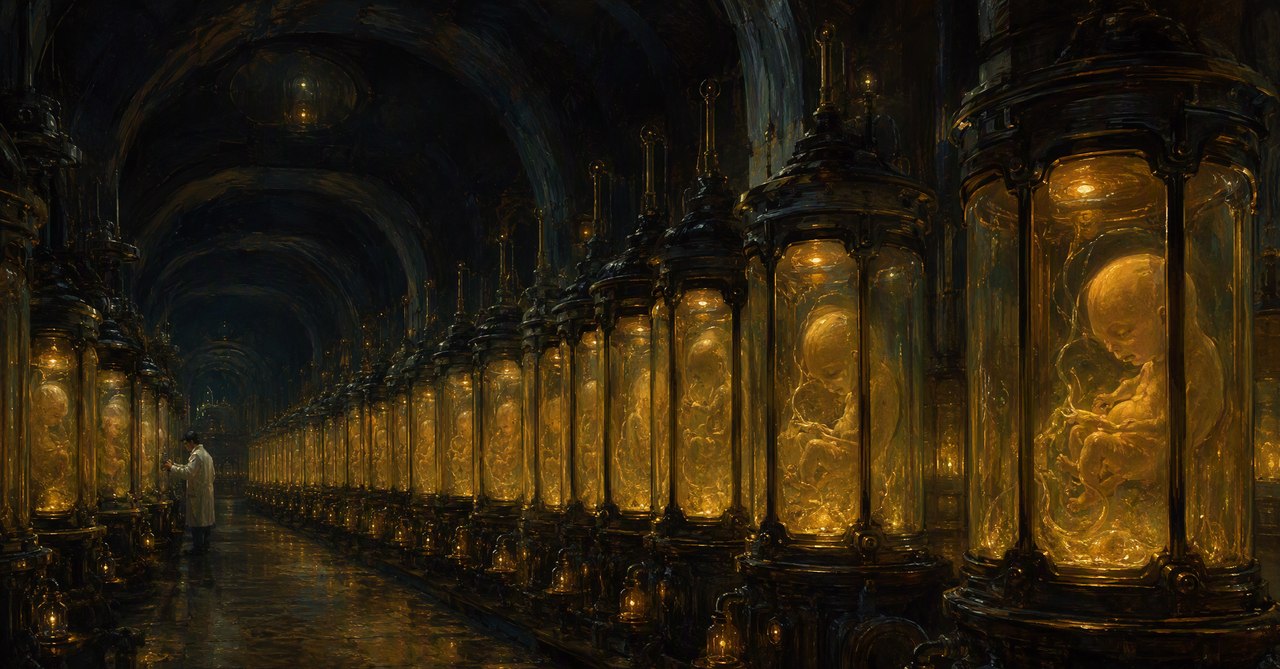
The Nursery Vault — the Mordant program's gestation floor, where the replacements are said to be grown in rows
THE ENVIRONS — The Nursery Vault — the Mordant program's gestation floor, where the replacements are said to be grown in rows. (An artist’s rendering; the place is invented.)
THE RECORD
The Geneticist embodies the canon's replacement claim — and its real shelf is the cloning record itself: Dolly the Sheep (1996), the first mammal cloned from an adult somatic cell, filed in the Library with what it proved and what it did not. The transmissions' clone grids are invented; the science they inflate is real, slow, and documented. That distance is the codex's whole method.
FILED IN THE ARCHIVE
WATCH NEXT — ON SCREEN
The Island (2005)Vat-grown doubles harvested for parts — the clone-grid panels rendered as a blockbuster, product launch and all.TMDB · YouTube
Moon (2009)The loneliest version of the question: a worker who learns what he is — and what the company thinks that means.TMDB · YouTube
The 6th Day (2000)Same-day replacement of the powerful — ‘they look the same, they sound the same.’TMDB · YouTube

AN INVENTED FIGURE — ANY RESEMBLANCE TO ANY REAL PERSON, LIVING OR DEAD, IS COINCIDENTAL AND UNINTENDED

← Aurelian StrohmKonrad Latham →
ASK THE CODEX
A companion voice briefed on the whole book. Answers are brief, sourced, and honest about the fiction frame.
Ask me anything — a chapter, a poster, a term, a source, or where to begin.