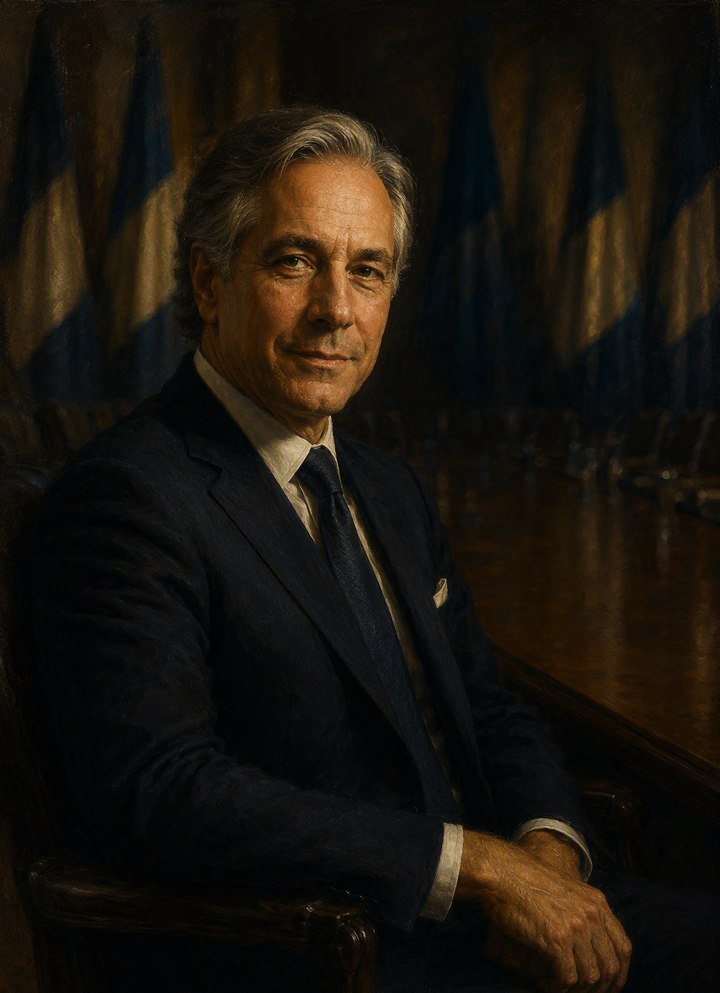
Commissioned portrait — rendered from the archive's description
SEAT III · THE DIRECTORATE
Konrad Latham
THE DIPLOMAT
Front: The architecture — one world government by consensus
The Directorate's envoy without portfolio: the codex's invented master of the communiqué, the framework, the non-binding resolution that binds everything. The transmissions call his front 'a totalitarian one world government in the name of utopia'; the annotators file him as the mythology's answer to a real shape — governance by document, drafted in language no one can object to and everyone can fear.
Origin
In the codex's telling, a treaty lawyer's son who grew up doing his homework in interpreters' booths, and learned before he could vote that the most powerful sentence in the world is the one that means slightly different things to every delegation — and means them on purpose.
The Rise
His rise is a pile of paper: the accord, the framework, the agenda with a year in its title. The codex shows him ascending through rooms that get longer and flags that get fewer, until the room is the Marathon and the flags are unmarked. The mythology reads the pile as the plan in the open. The record, filed below, reads it as what it is.
Current Assignment
He holds Seat III for the architecture front: the resolutions and agendas the transmissions cite as the plan's public paperwork. His office drafts the language; the Directorate's other seats supply the pressure the language is said to encode.
The Ritual Contract
His ritual contract is the genre's driest and, the annotators note, its most believable: a covenant to keep every promise non-binding, forever — power without signature, reach without clause. The transmissions draw it as a document notarized by no one.
Known Sayings
“Consensus is the slowest coup.”
“Nothing in this text is binding on anyone. That is why it is in the text.”
“You may read it. It is short. That is the point.”
Weaknesses & Tells
His tell: the phrase with a year in the title — the deadline that makes a wish read as a deadline. His weakness: the document is public, short, and free, and the codex's own Library links it below — the plan's public architecture is the one claim the reader can test in an afternoon.
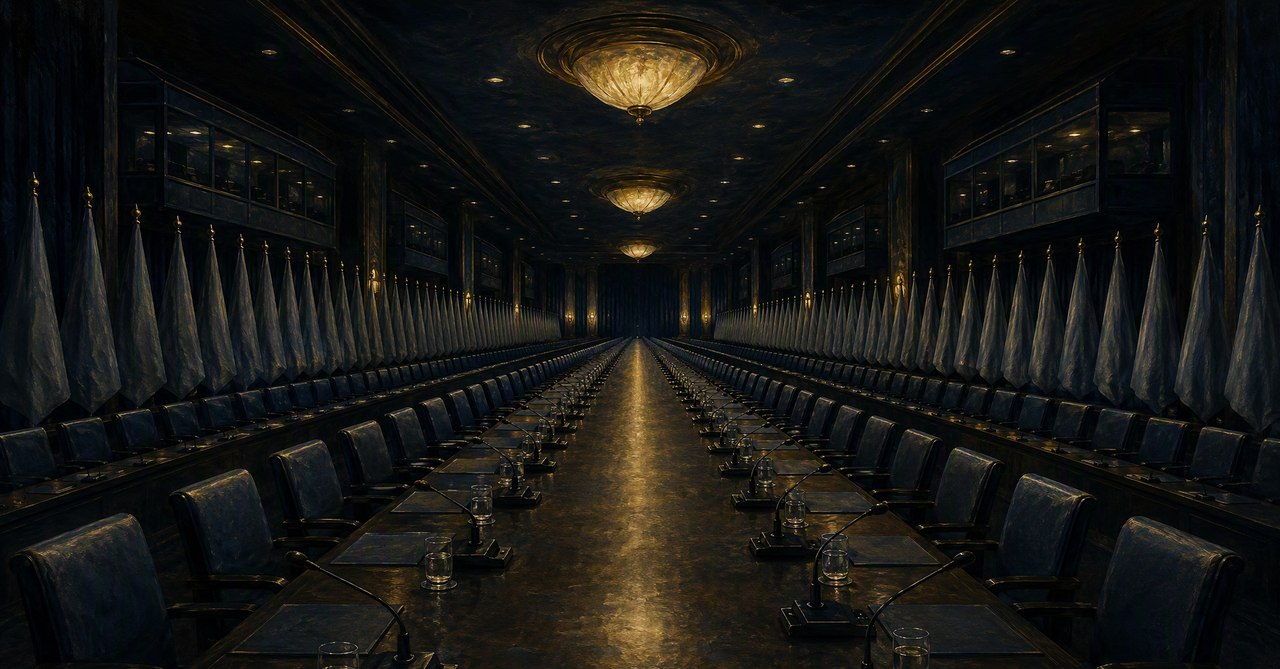
THE ENVIRONS — The Marathon Room — the endless conference chamber where the resolutions are said to be drafted, its flags deliberately unmarked. (An artist’s rendering; the place is invented.)
THE RECORD
The Diplomat embodies the canon's architecture claim — and its real shelf is the document itself: Transforming Our World, the 2030 Agenda (2015), seventeen goals, no enforcement mechanism, filed in the Library beside the readings it has gathered, including the Reuters fact-check of the 'own nothing' slogan. Latham is invented; the resolution is real, and the gap between them is the codex's teaching example.
The Adjustment Bureau(2011)The plan as a bureaucracy of doorways — the architecture claim as a love story, with hats.TMDB · YouTube
1984(1984)The literary ancestor of every panel — one party, one truth, ‘war is peace, freedom is slavery.’ The endgame in its classic form.TMDB · YouTube
HyperNormalisation(2016)The managed world as a consensual hallucination — Curtis’s deepest cut on engineered reality.TMDB · YouTube
AN INVENTED FIGURE — ANY RESEMBLANCE TO ANY REAL
PERSON, LIVING OR DEAD, IS COINCIDENTAL AND UNINTENDED