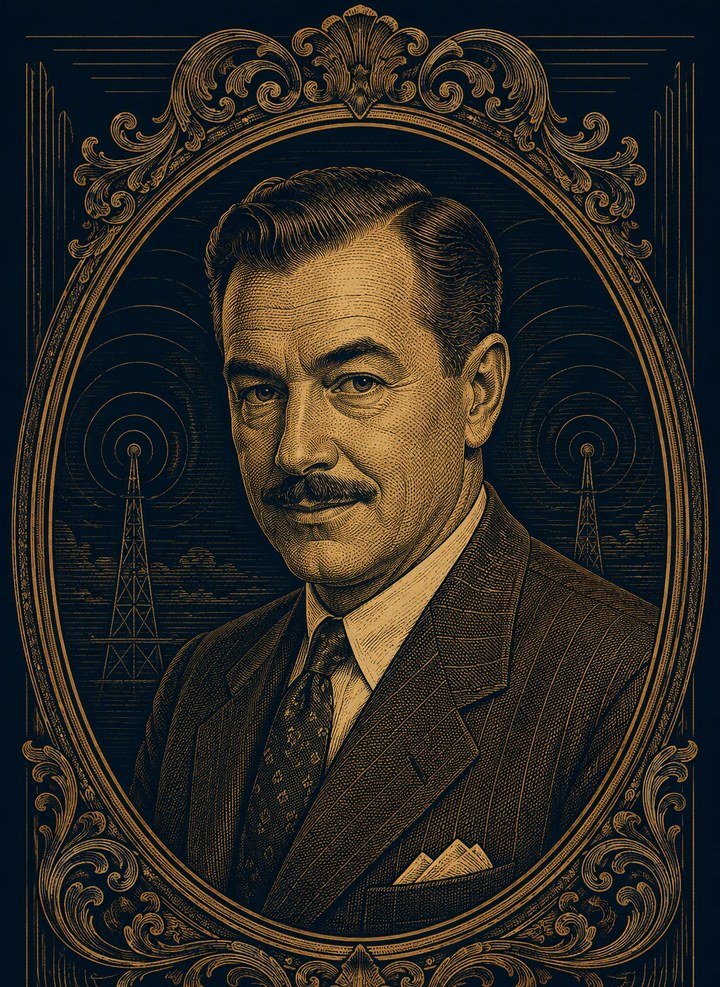
Sigmund Freud's nephew, the founding counsel of public relations — and the one figure in this whole archive who simply wrote the technique down, published it, and taught it. The canon quotes him as the plan's instruction manual. The record is stranger than the mythology requires: everything attributed to him in whispers, he said himself, in print, in 1928.
The Canon’s Reading
In the mythology, Bernays is the plan's quartermaster: the man who weaponized his uncle's psychology into mass control — the torches of freedom, the engineered news event, the invisible government. The transmissions' 'erode values and culture' panels are his vocabulary quoted back without his name.
The Record
The opening lines are real — Propaganda (1928) begins: 'The conscious and intelligent manipulation of the organized habits and opinions of the masses is an important element in democratic society' — and speaks without embarrassment of an 'invisible government' of propagandists. It is a textbook, written proudly, by its practitioner.
The campaigns are documented — The 1929 'Torches of Freedom' march — women's cigarettes staged as emancipation at the Easter parade — is a matter of advertising history. His early-1950s work for the United Fruit Company reframed Guatemala's elected government for American readers; the record of that campaign is in his own papers and the histories of the 1954 coup.
He named it himself — 'The engineering of consent' is his own 1947 phrase — an essay title, not an accusation. He lived to 103, gave interviews for decades, and never hid any of it.
The Afterlife
Adam Curtis's The Century of the Self (2002) turned Bernays into the documentary record's central teacher of the twentieth century's real influence craft. The codex's method was built for exactly his case: when the technique is published, taught, and sold, the word 'conspiracy' is doing the reader no work. The posters whisper what Bernays announced — and the Grounded Edition files the announcement, not the whisper.
The Century of the Self(2002)Adam Curtis on psychology and public relations — the scholarly backbone of every ‘erode values & culture’ column.TMDB · YouTube
The Power of Nightmares(2004)Curtis on the politics of fear — how manufactured nightmares become instruments of governance.TMDB · YouTube
The Precedents file real people, dead and documented — the canon’s
reading on one side, the public record on the other. For the codex’s invented figures, see
the Directorate.